3D printing and one-off parts, Townsville.
Two Formlabs 3D printers and a mechanical engineer on staff, in an auto electrical workshop. SLS, SLA and FDM, with the modelling done here as well — bring us the part and we can draw it, print it, and tell you which process the job needs.
We have copied parts from the broken original before.
- Two Formlabs printers on site
- A mechanical engineer on staff
- SLS, SLA and FDM
- Parts copied from a broken original
- One-offs through to short runs
The processes, and what each is for.
FDM — fused deposition modelling
Melted filament laid down in layers, in engineering thermoplastics. The most economical of the three, and the usual answer for jigs, fixtures, brackets, housings and larger parts where a fine surface finish is not the point.
SLA — stereolithography
Liquid resin cured by light. Fine detail and a smooth finish, and the most dimensionally accurate of the three. It suits small detailed parts, fit checks, patterns and anything where how it looks matters as much as how it holds up.
SLS — selective laser sintering
Nylon powder fused by a laser, with the unfused powder holding the part up as it builds. That means no support structures and no marks where they were removed, so internal features and geometry the other two cannot manage are possible. Tough and slightly flexible — the pick for a functional part that has to work rather than be looked at.
A mechanical engineer, in-house
The drawing is done here by a mechanical engineer on staff. You do not need a CAD file to start.
Copying a part nobody makes
We measure the original and draw it up here, then print as many as the job needs.
Choosing the right process
Each of the three trades something away. Strength, finish, cost and what geometry is even possible all move between them, so the honest answer is sometimes that printing is the wrong tool and a machined part or something off a shelf will serve you better.
A part copied, a display cylinder, and parts inside somebody else’s product.
A customer’s part came in and we drew it from the part itself, then printed four copies of it.
Each copy carries the slot and the pair of holes the original has. The finish is the giveaway — the original is smooth, and the printed ones carry the fine matt texture the printing leaves behind.
Mackenzie Hydraulics & Engineering needed display pieces for their trade stand — a full hydraulic cylinder model, and a range of hose fittings to go with it. Every part was modelled and printed by us.
A display piece tests the process in an unexpected way. Nothing on it has to hold pressure or take load, so the whole job comes down to how it looks and whether the parts fit each other properly — which is exactly where a printed part either reads as the real thing or does not.
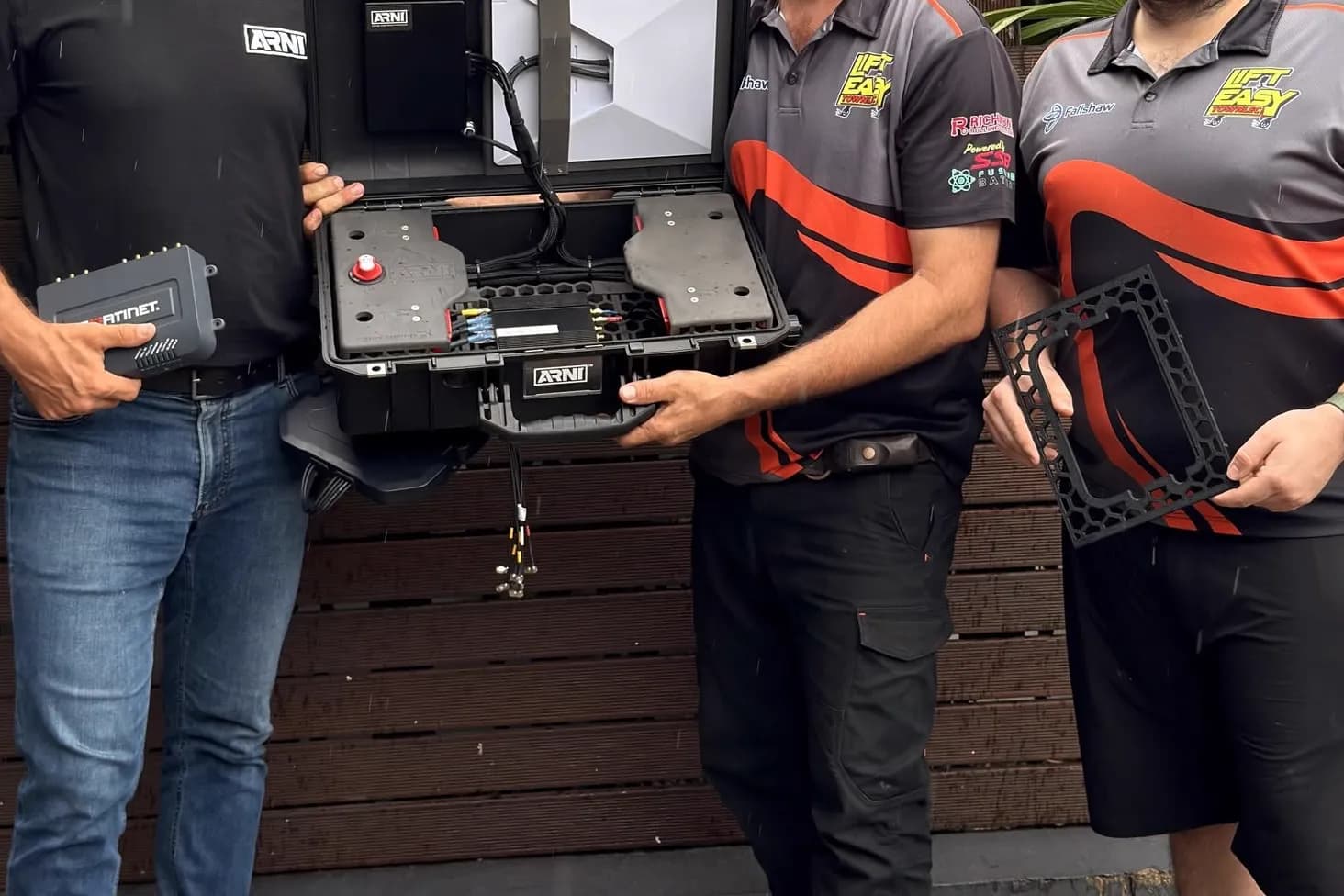
The AirBridge work asks for something else again. We make custom printed components for their ARNI rapid-deployment network cases — AirBridge describe them as mission-critical connectivity for disaster relief, defence and remote operations. Design tweaks through to final prints, done here.
That is a different job from a one-off. A part somebody else builds a product around has to come out the same every time, which is a standard rather than a single good result.
Three jobs, three different reasons to print. To make more of something, to show something, and to build something into somebody else’s product.
The parts, themselves.
Every job on this page, photographed — very different demands, all modelled and printed here.
A resin print, coming off the platform.
Twenty-five seconds of one of our Formlabs machines finishing a print. The parts build upside down, hanging off the platform in the resin tank, and get lifted clear at the end — which is why SLA parts come out with supports on them and a smooth face where the light hit.
Why a workshop has printers.
The printing sits in the same workshop as the auto electrical work. It is one job among several rather than a trade of its own.
3D printing questions, answered.
Can you print a part if I only have the broken original?+
What if I have no CAD file?+
Which process will my part need?+
Can you do a production run, or only one-offs?+
Will a printed part be strong enough?+
Do I have to be in Townsville?+
Do you only print for vehicles and machinery?+
Got a part nobody makes any more? That's the one we want!